in

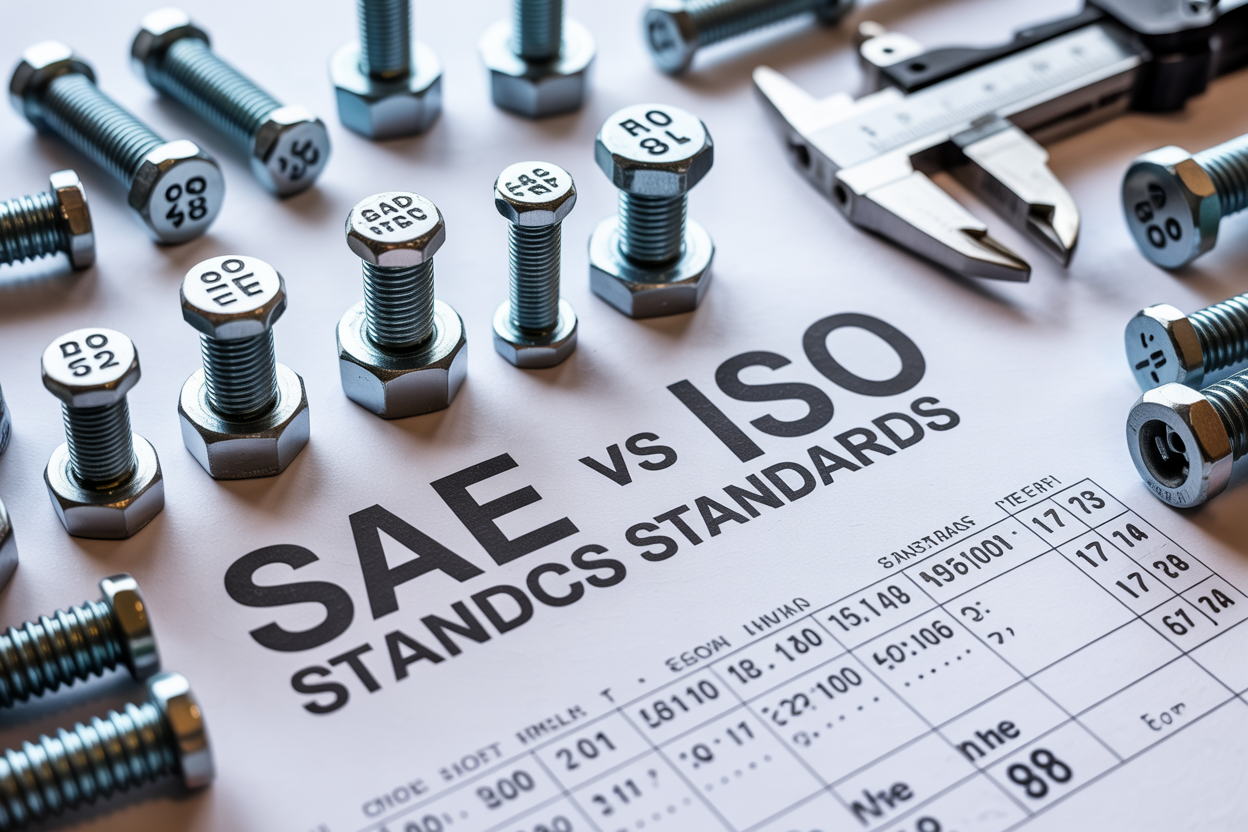
Choosing the Right Bolt Grade: A Comparative Analysis of SAE vs. ISO Standards for Automotive Safety.
When your vehicle’s safety depends on fasteners holding everything together at highway speeds, picking the wrong automotive bolt grades isn’t just a mistake-it’s a potential disaster. Automotive engineers and procurement specialists must understand these standards to ensure every connection is built on strength and locked in trust
The main difference between the two major grading systems for bolts is explained, as well as the appropriate use for both systems. You will learn how the SAE and ISO compare for use with suspension systems, motor mounts, and more, as well as a helpful tool for making the right decision so you don’t have the confusion of choosing the wrong system for your application based on the requirements for your region. The difference between the right grade of bolt and the wrong grade can mean catastrophe, so the importance of making the right decision is more than you might think.
Understanding Automotive Bolt Grades and Their Role in Vehicle Safety
How bolt grades determine load-bearing capacity and failure resistance
Bolt grades are standardised specifications that specify the mechanical characteristics of fasteners and directly determine the amount of force, tension, and stress they can withstand before failing. Tensile strength, yield strength, and hardness values are indicated by numbers and symbols that are stamped on bolt heads as part of the grade marking system.
Higher-grade bolts are subjected to specific heat treatment processes, and they are also designed with specific alloys that increase their strength limits significantly. For example, a Grade 2 bolt is only capable of handling up to 74,000 PSI of tensile stress, whereas an SAE Grade 8 bolt is capable of handling up to 150,000 PSI of tensile stress. This means that a Grade 8 bolt is capable of handling twice the weight of a Grade 2 bolt without breaking.
The metallurgical properties that contribute to these differences in strength are:
- Carbon content: The higher the carbon content, the harder and stronger something is.
- Alloy content: The presence of chromium, molybdenum, and nickel ensures that something lasts longer.
- Heat treatment: Quenching and tempering ensure that molecules are arranged correctly.
- Accuracy of thread pitch: Accurate manufacturing ensures that loads are spread correctly.
The load-bearing capacity is directly related to the thread engagement, bolt diameter, and material grade. Engineers use well-known formulas that take into account safety factors, changing loads, and environmental stresses to figure out these numbers. The proof load on the bolt is the most stress it can handle while returning to its original shape. The ultimate tensile strength is the point at which it breaks.
Why proper grade selection prevents catastrophic automotive failures
During normal use, parts of a vehicle are subjected to extreme forces that are greatly increased during crashes, emergency braking, or high-performance driving. Under these conditions, suspension systems, engine mounts, brake assemblies, and steering components all need properly graded bolts to stay strong.
Newer cars make a lot of force that older fastener standards can’t handle. Turbocharged engines make vibrations happen at higher frequencies, advanced braking systems make clamping forces stronger, and performance suspensions move heavier loads through their mounting points.
Critical automotive applications where bolt failure creates immediate safety hazards include:
- Wheel lug bolts: Inadequate grade selection causes wheel detachment
- Brake caliper mounting: Weak bolts lead to brake system failure
- Suspension joints: Incorrect specifications result in handling loss
- Engine mount bolts: Improper grades cause catastrophic engine movement
- Steering column fasteners: Wrong bolt selection compromises vehicle control
Temperature cycling makes things even more complicated. Parts in the engine bay go through cycles of heating and cooling that make them expand and contract. Under these conditions, bolts that don’t have high enough grade ratings slowly come loose or develop stress fractures.
The financial and safety costs of using incorrect bolt specifications
Using bad or wrongly graded bolts can cost manufacturers, repair shops, and vehicle owners money right away and put them at risk of lawsuits in the future.
Costs related to safety go far beyond the costs of repairs right away. When fasteners fail and affect important systems, car makers have to deal with huge recall campaigns. The recall of the Toyota accelerator pedal had to do with bolts that cost more than $1.1 billion to fix and settle.
When processing claims, insurance companies are paying more and more attention to how things are maintained and the specifications of parts. Using the wrong bolt grades can void warranties, raise insurance costs, and make repair shops legally responsible.
If professional mechanics install bad fasteners and accidents happen because of them, they could lose their certifications and be sued. Beyond repair costs, they face potential medical expenses, lost wages, and decreased vehicle resale values. The hidden cost of using cheap bolts in critical applications can literally be measured in lives and permanent disabilities.
SAE Bolt Grading System: Strengths and Applications in North American Markets
Grade marking system that simplifies identification for technicians
Even in difficult working conditions, mechanics and engineers can easily recognise SAE bolt grades thanks to their simple marking system. SAE Grades 2, 5, and 8-the most popular automotive grades-use unique head markings that eliminate guesswork during assembly and repairs.
Grade 2 bolts are easily identifiable as the standard strength option because they have no markings on the head. Grade 8 bolts have six radial lines on the head, compared to three on Grade 5 bolts. When performing fast roadside repairs or in poorly lit engine bays, where technicians must quickly select the appropriate fastener, this visual system performs admirably.
There is more to the marking system than just radial lines. In order to create traceable record quality control, manufacturers frequently include their identification marks alongside grade indicators. This dual-marking approach helps automotive professionals verify both the strength characteristics and the source of their fasteners, which proves invaluable during warranty claims or safety investigations.
Proven track record in high-stress automotive applications
Decades of dependable performance in demanding automotive environments have cemented the reputation of SAE graded bolts. Grade 8 bolts are frequently used in connecting rod applications, where they must endure thousands of combustion cycles while upholding exact torque requirements.
SAE Grade 5 bolts are essential to engine block assemblies because they provide the best possible balance between strength and ductility. These fasteners work well in situations where constant stress variations are caused by thermal expansion and contraction. In real-world driving conditions, properly specified SAE bolts consistently meet or surpass their rated fatigue life, according to a wealth of field data gathered by the automotive industry.
Another area where SAE bolts excel is in suspension components. SAE Grade 5 and 8 bolts are essential for maintaining structural integrity in control arm bushings, strut assemblies, and steering components over millions of road impact cycles. SAE Grade 8 bolts frequently withstand extreme lateral forces that would destroy lesser fasteners, pushing these limits even further in racing applications.
Wide availability and cost-effectiveness for domestic manufacturers
North American automotive manufacturers have an existing supply chain infrastructure that assures SAE bolts are readily available at competitive pricing. The top fastener distributors have SAE bolts available in virtually every size and length combination required for the manufacture of automobiles.
The well-developed supply chain for SAE bolts also assures economies of scale, which equate to lower cost per bolt compared to specialty bolts. This cost savings can be substantial when considering the number of bolts required for each assembly. North American automakers have the opportunity to source SAE bolts from multiple sources, which helps keep the cost at an acceptable level.
Standardized testing protocols that ensure consistent quality
The mechanical properties are ensured by the rigorous testing requirements as specified by the SAE standards. The tests for the tensile strength of the bolts are conducted according to a specific procedure, which ensures the ultimate strength, yield strength, and elongation properties of the bolts.
The specific requirements for the hardness tests ensure that the strength levels of the SAE bolts are maintained over the service period. The Rockwell hardness tests conducted at specific depths ensure the correct heat treatment of the bolts, whereas the impact tests ensure that the bolts can withstand sudden shocks without breaking.
Quality control is not limited to the mechanical properties of the bolts. The quality control requirements for the SAE bolts specify the exact tolerances for the dimensions of the thread, the head, and the length of the bolt. This ensures that the SAE bolts can be used with the standard nuts and washers without any problems, thereby ensuring the quality of the joints. The requirements for the audits ensure that the manufacturers maintain the calibration of the testing equipment as well as the documentation for the quality control procedures, thereby providing a paper trail for the product liability.
ISO Bolt Standards: Global Approach to Automotive Fastener Excellence
Property Class System Offering Precise Strength Specifications
The ISO property class system offers automobile engineers mechanical property data that goes well beyond the broad definitions offered in other standards. The property classes are defined by a set of numbers separated by a decimal point. The first number represents the tensile strength, and the second number represents the yield to tensile ratio * 10.
The property classes vary from 3.6 for low-strength applications to 12.9 for ultra-high-strength critical components. The 8.8 property-class bolts offer a minimum tensile strength of 800 MPa and a yield strength of 640 MPa. The 10.9 property-class bolts offer 1000 MPa tensile and 900 MPa yield. Such accuracy allows automobile engineers to choose the exact level of strength required for a specific job without over-engineering or compromising safety factors. The system also offers specific chemical composition requirements and testing for each property class. Such standardization eliminates the guesswork that can plague automobile assembly activities.
International Compatibility Reducing Supply Chain Complexity
ISO standards ensure a seamless integration of global automotive supply chains with a uniform set of specifications, which can be implemented by manufacturers globally. This compatibility removes the need for different bolt inventory levels when procuring components from different nations or exporting vehicles to different nations.
Major automobile manufacturers can experience a smooth procurement process when all their vendors are using ISO standards. A bolt size can be used in manufacturing plants in Germany, Japan, Mexico, and China without any change or without taking into consideration different variations in national standards.
The use of a metric thread system in ISO standards is consistent with current design practices in the automotive industry, where metric system usage is predominant in engineering drawings and specifications.
Compatibility of ISO standards is also experienced in different nations when conducting quality assurance tests, as different nations can use uniform quality assurance test protocols without any variations, resulting in a smooth quality assurance process.
Comprehensive Documentation Standards for Quality Assurance
ISO standards have specific documentation requirements that ensure a high level of traceability from the raw material to the end product. The documentation for the bolt lot should include the results of the chemical analysis, mechanical properties, as well as the verification of the coatings.
Test certificates are used to specify the exact procedures, samples, and acceptance criteria for the tests carried out, which may include tensile tests, proof load verification, as well as hardness tests. The documentation ensures that the quality teams for the automobile industry can verify the quality of the bolts before they are installed on the assembly line.
There are specific requirements for the supplier, which ensure that the supplier can maintain a consistent quality level over the contract period for the automobile industry. This documentation ensures that the quality of the bolts is not compromised, thereby protecting the manufacturer’s reputation.
Tags :
example, category, and, terms